San José Task Force Meeting
2026
March


AlphaX team reports "real momentum" from General Plan review focused on implementation, not just policy
April 2025 — San José, CA
San José is taking a proactive approach to California's housing transformation, choosing to lead rather than react as the state's residential landscape undergoes dramatic change over the next decade.
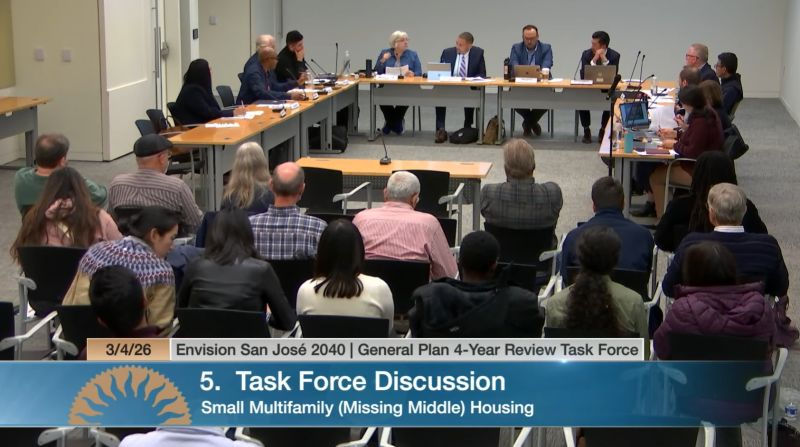
This momentum was evident at Tuesday night's Task Force Meeting #4 for the Envision San José 2040 General Plan Four-Year Review, where city officials and developers gathered to discuss Missing Middle and small multifamily housing implementation.
Beyond Policy to Implementation
What set this session apart, according to attendees, was the city's willingness to confront the hardest part of housing policy: moving beyond what looks good on paper to what can actually be built in real neighborhoods with real constraints.
"We don't feel this often in housing: real momentum—and real effort from the public side to open the door to responsible private delivery," said the AlphaX RE Capital team following the meeting.
The discussion focused not just on zoning changes, but on practical realities including infrastructure constraints, financing mechanisms, and realistic timelines for development.
Preparing for Inevitable Change
With state legislation including SB 9, expanded ADU laws, and the Starter Homes Revitalization Act (SB 684/SB 1123), California's residential neighborhoods will transform significantly over the coming decade—whether cities are prepared or not.
San José appears to be choosing preparation over reaction.
The city is exploring a more flexible, implementation-ready pathway that could upzone residential neighborhoods to allow approximately 32 units per acre, while avoiding the barriers that have limited housing production in other jurisdictions.
Public-Private Partnership in Action
"Housing doesn't get built by one party alone," AlphaX noted. "It gets built when public leadership creates clear and welcoming policy, and private builders can commit capital and execution with confidence."
The development team emphasized they could feel genuine effort from the public sector—not just holding meetings, but working to create pathways where private developers can participate responsibly and predictably.
Leadership Recognition
AlphaX representatives—including CEO & Founder Stephanie Yi, Junior Partner and Chief Asset Management Officer Jia Li, and Director of Development Ruby H.—expressed appreciation for the city's leadership.
They specifically thanked:
Carlos Rosario, Task Force Chair
Melissa Bickford, Vice Chair
Charles Cantrell and Michael Young, Planning Commissioners
Christopher Burton, Director of Planning, Building & Code Enforcement
Kora M., Planner
Jerad Ferguson and Ruth Cueto, Principal Planners
The acknowledgment highlighted these officials' "policy leadership and for engaging directly with the practical realities of housing delivery."
Substantial Local Investment
AlphaX's commitment to San José is already substantial. The firm's current pipeline includes approximately 300 units across 77 projects, encompassing:
Accessory Dwelling Units (ADUs)
SB 9 developments
SB 1123 starter home projects
Larger community projects moving through the General Plan Amendment (GPA) process
Long-Term Commitment
"We're proud of what's underway—and even more committed to investing in San José for the long term," the company stated. "We're ready to keep showing up, not just to speak—but to help prove that Missing Middle housing can move from policy → permits → shovel-ready reality."
What is Missing Middle Housing?
Missing Middle Housing refers to multi-unit residential buildings that fit the scale of single-family neighborhoods, including duplexes, triplexes, fourplexes, and small apartment buildings. These housing types can increase density and affordability while maintaining neighborhood character.
San José's approach represents a shift from resistance to intentional shaping of inevitable change—creating policy frameworks that enable responsible development while addressing the state's housing crisis.
The Path Forward
As California faces continued housing shortages and affordability challenges, San José's willingness to create clear, implementable pathways for Missing Middle housing could serve as a model for other cities navigating similar transformations.
The collaboration between city officials and local developers like AlphaX suggests that thoughtful policy combined with private sector execution could help bridge the gap between housing aspirations and reality.
The Envision San José 2040 General Plan Four-Year Review continues with additional task force meetings scheduled throughout 2025. Public participation is encouraged.